Behind the Build: a bilingual website for a Gatineau music venue
A venue site has one job on a Friday night: tell people what is on, when the doors open, and how to get a table. Nash had to do it in two languages.
A live music venue does not need a large website. It needs a site that answers a handful of questions quickly, on a phone, often a few hours before the show: who is playing tonight, when do the doors open, how much is it, can I still get a table, and where do I park. In Gatineau, those answers have to work in French first and in English for the many visitors who cross the river from Ottawa.
The Nash website in our portfolio was built around exactly that list. It is now kept as a portfolio demo at nashqc.com/showcase, and this piece describes what is visible there and what the project taught us about bilingual venue sites. It claims no outcome, traffic figure, or booking number; it is a description of the work.
The need, as far as the public site states it
The showcase describes Nash as a music hall, cocktail bar, and video lottery lounge on boulevard Gréber in Gatineau, with a main room of 255 seated and standing, VIP lounges, and shows on Friday and Saturday nights. The text sets the venue “eight minutes from downtown Ottawa,” which explains the bilingual requirement better than any policy could: a meaningful share of the audience reads English, while the venue, its programming, and its local market are French.
Beyond listing shows, the site had to handle the practical side of a night out: a table reservation path, a menu, the house rules at the door (18 and over, identification required), hours, parking, and a contact route for private events and room rentals. Each is a small task, and each has to be complete in both languages or the site fails the person who needed it.
What the site had to do in two languages
The showcase is served in French by default with lang="fr-CA", and the English version lives under /en/, declared as en-CA. A compact “FR / EN” toggle sits in the header beside the opening hours, and every section has a direct counterpart: Accueil, Calendrier, Menu, Réserver, and Contact map to Home, Calendar, Menu, Reserve, and Contact.
Two details stand out. First, the translations are written for the audience rather than transposed word for word. “Salle principale” becomes “Main room,” “Tables 8 restantes” becomes “Tables 8 left,” and the French “21h00” becomes “9:00 PM” in English, which is how each reader actually tells time. Second, the forms are fully bilingual, including the parts that are easy to forget: field labels, the note that fields marked with an asterisk are required, the occasion and seat-type options, and the line explaining that a deposit may be requested for some evenings. A reservation form that switches back to French at the last step is the kind of gap we wrote about in planning a bilingual website for Ottawa–Gatineau, and the Nash site avoids it.
The menu page follows the same rule. Wines, beers, and cocktails are listed with short tasting notes and prices shown with tax included, in both languages, so a visitor can decide at the bar without a conversion in their head.
Show listings fed by Hedliner
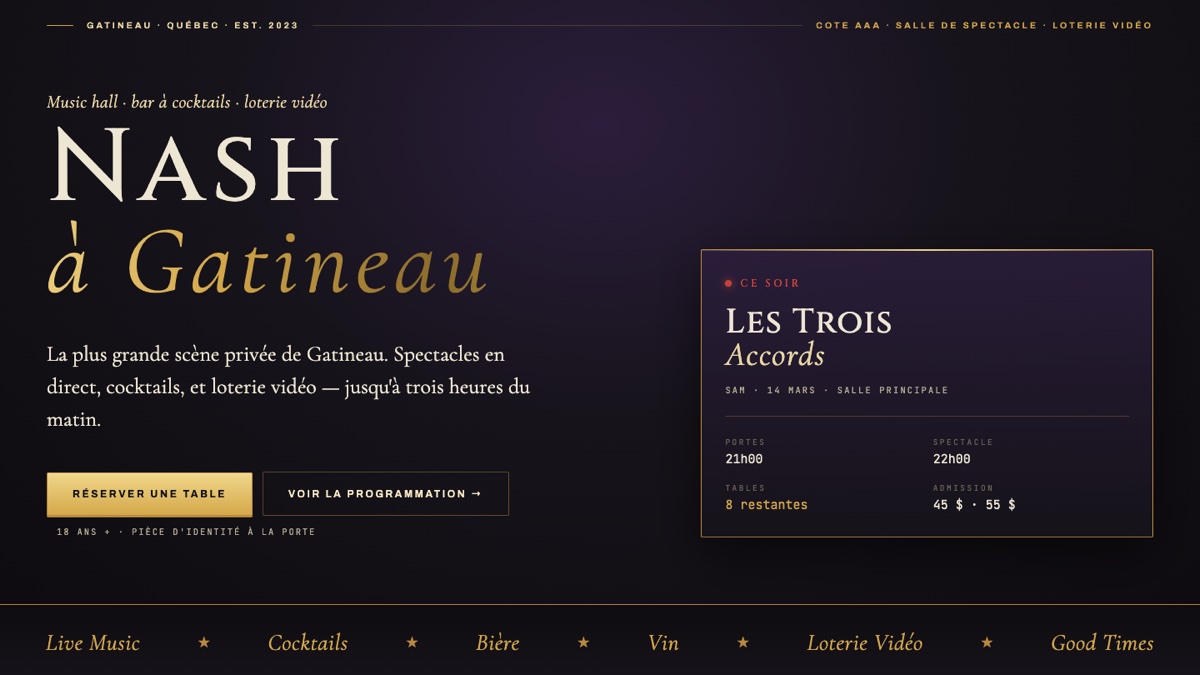
The centrepiece of the homepage is the lineup. A “Ce soir” (Tonight) card carries the headliner, the room, door and show times, tables remaining, and admission at the door and online. Below it, “À l’affiche ce mois-ci” lists the month’s shows with the same fields, a “Door” or “Waitlist” status, and a link to the full calendar. The block ends with a small credit: “Propulsé par Hedliner.”
Hedliner is Red Comet’s own browser-based platform for the live music community, currently in live alpha. Its public pages describe booking software for venues in which announced shows appear on the venue’s public Hedliner page and the Public Events API “lets your website pull the same calendar with a venue API key.” Our portfolio record describes the original Nash site the same way: its live show listings were powered by Hedliner, so the website displayed the venue’s announced shows rather than keeping a second copy that someone had to update by hand.
Two honest caveats. The preserved showcase keeps a fixed sample lineup so that the design can be seen as it was intended, with a full card and a full month; it is not pulling live dates today. And the venue’s live calendar page currently reads “Aucun spectacle à afficher pour le moment,” which is the correct empty state for a listings feed with nothing announced. An empty state that says so plainly is part of the design, not a failure of it.
The design character
The site’s look is in the cover image above: a near-black purple backdrop, gold serif typography, and a hero that reads “Nash à Gatineau” in two weights, the roman name and the italic place. The featured concert card sits to the right with a thin gold border, mono-spaced labels for doors, show, tables, and admission, and a red “Ce soir” marker. A gold rule under the hero carries a marquee: live music, cocktails, beer, wine, video lottery, good times.
The palette does a practical job as well as an aesthetic one. Gold on dark purple gives the show times and prices high contrast where it matters, and the restrained type sizes let a long list of shows stay readable on a phone. The venue’s character, late hours and a stage, is carried by the colours and type rather than by stock photography.
What we learned about bilingual venue sites
The listings are the site. Most of the page is structure around one living element. If the lineup is wrong or stale, nothing else on the page can compensate, so the data source matters more than any visual decision. Feeding the site from the venue’s own booking tool, rather than from a page someone edits, is the choice that keeps a venue site trustworthy.
Translate the states, not just the pages. “Waitlist,” “Tables 8 left,” “No shows to display at the moment,” and the deposit note are where bilingual sites usually slip. Writing those strings in both languages from the start costs little and is hard to retrofit.
Time, money, and age rules are local. Door times in 24-hour French and 12-hour English, prices in Canadian dollars with tax included, the 18+ rule, and a responsible-gaming line in the footer are all small, and all of them are the difference between a site that reads as local and one that reads as translated.
Preserve the demo on its own path. The venue’s homepage at nashqc.com now shows a short closing notice, while the design remains viewable at /showcase and /en/showcase. Keeping the demo at a stable address, separate from the live homepage, lets the work be seen without implying the venue is still booking shows.
Status
Nash is listed in our portfolio as a preserved demo rather than an active project. You can explore it, in either language, from the apps and websites page.
If you run a venue, restaurant, or bar in Gatineau and your site needs to carry a changing programme in French and English, our Gatineau web design page explains how we approach that kind of work.
Sources
- Nash showcase, French: nashqc.com/showcase
- Nash showcase, English: nashqc.com/en/showcase
- Nash calendar, menu, reservation, and contact pages: /calendar, /menu, /reserve, /contact
- Hedliner: hedliner.com, Hedliner for venues, Public Events API documentation
- Red Comet portfolio: /apps/